
Figure 1. Lead instructors Cevahir Koprulu and Adam Thorpe help interns troubleshoot a motor control circuit.
Internship Structure and Support
An expanded partnership connects local high school students directly with researchers to engage in the design and implementation of autonomous systems. The AutoDriveLab Internship, a collaboration between The University of Texas at Austin’s Center for Autonomy and the Del Valle Independent School District (DVISD), recently completed its inaugural cohort. Throughout the fall semester (Figure 1), interns worked alongside graduate students and postdoctoral researchers from the Center for Autonomy to design, assemble, and program autonomous vehicles.
The internship is funded by the Army Educational Outreach Program (AEOP), a U.S. Army–sponsored initiative. AEOP programs provide opportunities for student interns to work in active research environments alongside professional researchers and engineers, with the objective of strengthening the national STEM workforce supporting the U.S. Army, the Department of Defense, and related industries.
Initially proposed as a summer opportunity for only two high school students, the internship was scaled to a year-long cohort hosted at Del Valle High School (DVHS), expanding from just two students to a full classroom of 30, greatly broadening the program’s reach and impact (Figure 2).
Professor Ufuk Topcu provided strategic leadership on the program’s design and objectives and secured grant funding with support from program leads. Technical Project Manager Meredith Albers led program coordination and operational planning for the internship. Program details were developed and carried out in collaboration with Adrian Gutierrez, DVISD STEM Director, and Ryan Ragan, CTE Coordinator. At the campus level, Antonio Maldonado and Jacob Tamez, Del Valle High School faculty, managed the integration of program activities into students’ academic schedules and coursework.
Mr. Gutierrez emphasized the student impact, noting, “This partnership has been incredibly exciting for our students. Seeing them engage with real engineering systems and University of Texas researchers has raised their confidence and interest in pursuing STEM pathways.”
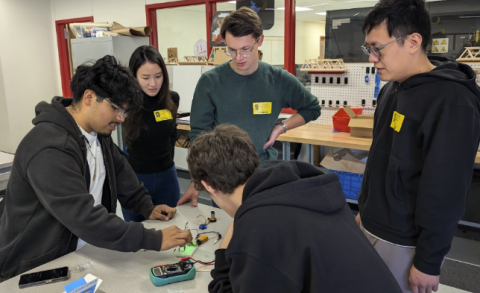
Figure 2. Teamwork between DVISD interns and UT Austin mentors Su Ann Low, Michal Podolinsky, and Philip Zhao during the fall hardware phase.
Community Engagement
Community engagement is a formal requirement within the Center for Autonomy. Graduate students and postdoctoral researchers in Professor Topcu’s group must complete a minimum of eight hours of structured outreach per semester as a condition of group membership. The internship therefore benefits both groups: interns gain applied engineering experience, and UT researchers strengthen their ability to translate advanced technical concepts into instruction.
Emphasizing the program’s role in workforce development, Professor Topcu stated, “Programs like this create a direct pipeline between secondary education and university research. Students encounter real engineering problems early, and our graduate researchers gain experience mentoring and managing technical projects.”
Curriculum and Instruction
During the fall term, instruction focused on hardware systems and electrical engineering. Interns worked in teams to construct robots from discrete components. The curriculum emphasized system-level understanding rather than assembly of preconfigured kits.
Students were required to analyze the function and integration of each component—including sensors, motor drivers, power regulation, and control interfaces—within the overall vehicle architecture.As a result, students developed foundational skills in circuit design, systems integration, troubleshooting, technical documentation, and collaborative problem-solving—core competencies aligned with undergraduate engineering preparation.
Mr. Maldonado observed, “For many of our students, this was their first experience working with university researchers and advanced engineering systems, which made the learning especially impactful.” Mr. Tamez agreed, adding, “It has been exciting to watch students work directly with the robotics hardware and see how they approach problem-solving in a real research environment.”
The program’s technical framework was developed by lead instructors Dr. Christian Ellis, Dr. Adam Thorpe, Cevahir Koprulu, and Will Ward. They developed the instructional sequence, exercises, and assessment materials used throughout the semester.
Dr. Ellis described the intent of the program structure:
“The objective is to expose students to authentic engineering workflows while enabling them to evaluate potential academic and career paths. The program demonstrates that complex technical projects are accessible through systematic problem-solving and sustained effort.”
This framework supported a team of eleven instructors and ensured consistent technical guidance across all course modules (Figure 3).
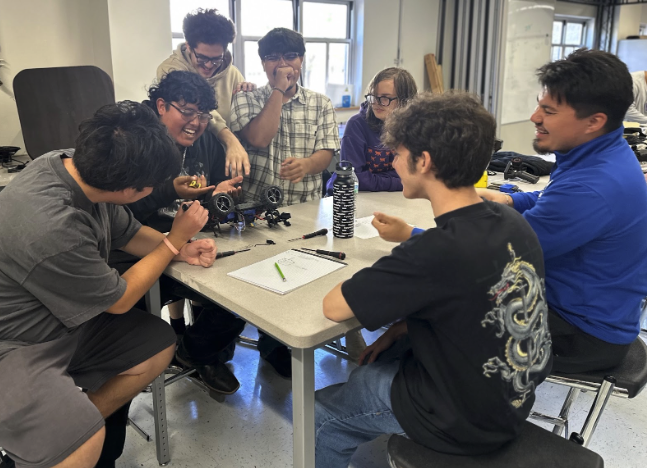
Figure 3. High school interns from Del Valle ISD collaborate on the mechanical assembly of their custom-built robots, applying foundational mechanical and electrical engineering concepts in a team-based environment.
Upcoming Plans
With the hardware phase complete (Figure 3), the spring semester will transition to software development and autonomy. Students will implement Python-based control and navigation algorithms to convert their manually operated vehicles into autonomous platforms.
The spring curriculum includes a visit to UT Austin’s research laboratories, allowing interns to observe how their vehicle platforms correspond to ongoing research programs. Dr. Thorpe noted, “The robots the students work with are directly connected to ongoing research at UT on algorithms for high-speed off-road autonomy. Students will see how classroom activities map to real research problems.”
The program is scheduled to conclude in May with a final showcase. Students will demonstrate system performance under autonomous operation, testing their vehicles on pre-designed courses that assess navigation accuracy, obstacle avoidance, and system reliability. Graduate student and postdoctoral mentors will provide technical feedback, reinforcing principles of iterative testing, debugging, and performance optimization.
For additional details, please see the Center for Autonomy’s Fall 2025 Outreach Report.