IEEE Spectrum featured Ufuk Topcu, director of the Center for Autonomy and professor at the University of Texas at Austin, in a recent article on the growing role of generative AI in space exploration.
The article, “Generative AI Gives Spacecraft the Autonomy Engineers Once Feared,” by Jackie Snow, examines how researchers are testing whether nondeterministic systems like generative AI can give spacecraft more flexibility to interpret their surroundings, plan tasks, and eventually make decisions on their own. It covers recent efforts including NASA’s use of AI to plan Mars rover drives and AI models tested aboard the International Space Station.
Professor Topcu offered his perspective on managing the risks of autonomy in space. “It has been mind-boggling to me how little autonomy we have in space applications,” he said, noting that space is exactly where human involvement is extremely hard, the stakes are high, and systems need to act fast.
He emphasized that the goal cannot be to guarantee that autonomous systems will never do anything wrong. Because these systems are most useful in situations humans cannot anticipate, he said, researchers should start with restricted applications, learn how the systems behave, and gradually expand where and how they are used. In his view, the central question is how well deployment risk is managed, not whether it can be eliminated.
Topcu also pointed to how quickly the space industry is changing. “Space used to have very slow innovation cycles,” he said. “They would think of a mission concept and spend 10 or 15 years on it. It’s not like that anymore.”
Read the full article at IEEE Spectrum.
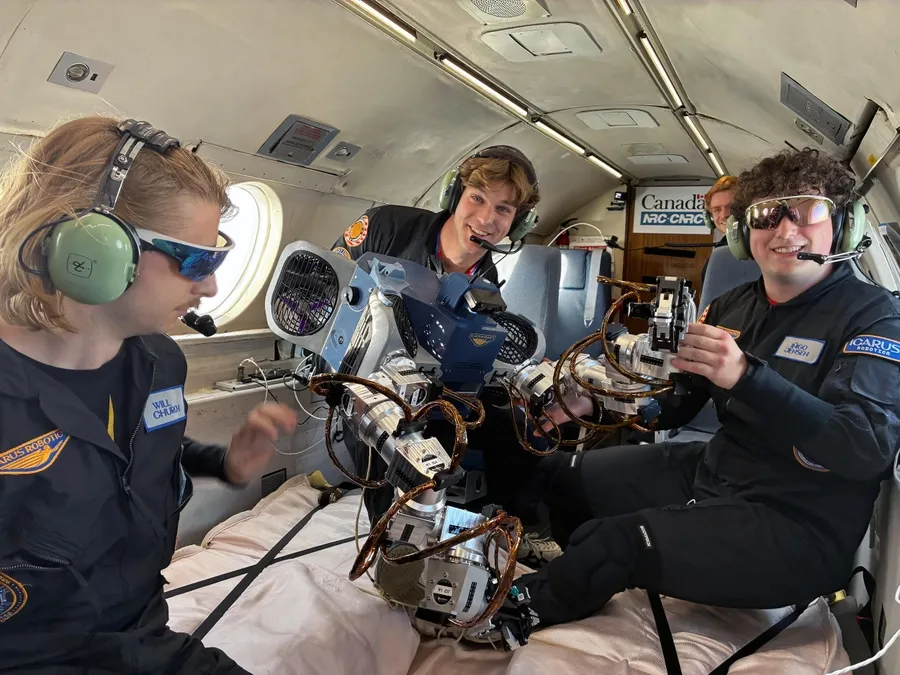
Photo Credit: Icarus Robotics